


Page 40 - MG Magazine
P. 40
carus frenatus, better known as parrotfish,   COLOUR AND PROTECTION
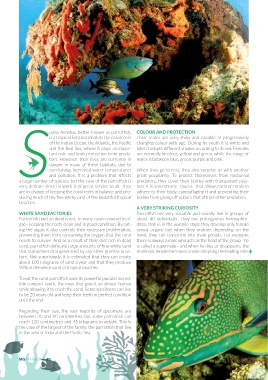
                       is a tropical fish that inhabits the coral reefs   Their  scales  are  very shiny and capable  of progressively
                       of the Indian Ocean, the Atlantic, the Pacific   changing colour with age. During its youth it is white and
                       and the Red Sea, where it plays an impor-  later it adopts different shades according to its sex. Females
                       tant role and finds protection from preda-  are normally bicolour, yellow and green, while the range of
                       tors.  However, their  lives are currently  in   males is between blue, green, purple and pink.
                       danger  in  many of these  habitats,  due to
                       overfishing, increased water temperatures   When they go to rest, they also surprise us with another
         Sand  pollution.  It  is  a  problem that  affects   great  peculiarity.  To protect  themselves from  nocturnal
          a large number of species, but the case of the parrotfish is   predators,  they cover their  bodies with  transparent  pyja-
          very delicate since its work is of great service to all. They   mas. It is a membrane –mucus– that allows parts of corals to
          are in charge of keeping the coral reefs in balance and pro-  adhere to their body, camouflaging it and preventing their
          ducing much of the fine white sand of the beautiful tropical   bodies from giving off odours that attract other predators.
          beaches.
                                                              A VERY STRIKING CURIOSITY
          WHITE SAND FACTORIES                                Parrotfish  are  very  sociable  and  usually  live  in  groups  of
          Parrotfish feed on dead coral –in many cases covered in al-  about  40 individuals.  They are protogynous  hermaphro-
          gae– keeping the reefs clean and in good condition. By eat-  dites, that is, in the juvenile stage they develop only female
          ing the algae, it also controls their excessive proliferation,   sexual  organs  but  when they mature,  depending  on the
          preventing them from consuming the oxygen that the coral   need,  they can  transform  into  male  gonads.  For example,
          needs to survive. And as a result of their diet rich in dead   there is always a male who acts as the head of the group –he
          coral, parrotfish defecate large amounts of fine white sand   is called a supermale– and when he dies or disappears, the
          that outnumber that generated by any other process in na-  dominant female becomes a male adopting the leading role.
          ture. Not surprisingly, it is estimated that they can create
          about 100 kilograms of sand a year and that they produce
          90% of the white sand of tropical beaches.

          To eat the coral parrotfish uses its powerful jaw and incred-
          ible compact teeth, the ones that give it an almost human
          smile allowing it to crush the coral. Some specimens can live
          to be 20 years old and keep their teeth in perfect condition
          until the end.

          Regarding  their  size,  the  vast  majority  of  specimens  are
          between 30 and 90 centimetres, but some parrotfish can
          reach 120 centimetres and 45 kilograms in weight. This is
          the case of the largest of the family: the parrotfish that live
          in the area of India and the Pacific Sea.


         MG MAGAZINE 40

